
The 2026 Emancipation Day Poetry Contest: The Winning Works
We are thrilled to share the winning entries from the third annual Emancipation Day Poetry Contest, hosted by the London Black Heritage Council (LBHC) in partnership with Spoken Culture and Antler River Poetry, with generous support from Fanshawe Pioneer Village. This year’s theme was ‘Vision for the Future’ and here’s what judges Christina Lord, Matthew Dawkins & Harold Usher had to say about all the entries:
“We [the judges] were impressed by each submission; the entries encouraged us to expand our imagination to consider what emancipation might mean for different people and how freedom can be understood as achieved, ongoing, and hoped for at the same time in various facets of Black livelihood globally. Over two deliberation sessions and thorough conversations we ultimately decided on the poems which withstood each of our requirements for strong poetic language and introduced emancipation in a complex and compelling way. Again, congratulations to all contestants, it was a pleasure to read and impacted by your words.”
Check out the winning poems below!
1st Place: “The first morning” by Elham Sarmastzada
The first morning

I constantly keep thinking about that first morning.
My mom just stood in the yard doing absolutely nothing.
Just inhaling.
She claimed it was the first time air didn’t feel borrowed.
My dad touched like dirt as if it was new.
It wasn’t, but he was.
We ignited a fire for no reason.
My brother question why.
I said “because we can”
That was the entire point
My grandma casually sat on the steps muttering names.
Just names. No last surnames.
She stated “they tried to make us forget we were people.”
A stranger approached the gate.
Requested for water.
My mom gave it.
Not because she had to.
At night we danced horribly.
And I came to figure out freedom isn’t a speech.
It’s standing in your own yard.
Choosing to be benevolent.
Dancing off-beat on purpose.
That’s it.
Elham Sarmastzada has won 1st Place for their poem “The first morning.”
Judge’s note: In understanding emancipation as evidenced by self-autonomy, “The first morning” re-introduces emancipated life as everyday action, thereby broadening the scope of emancipation and encouraging readers to investigate the theme through an interpersonal lens. Are we bearing witness to true self determination for Black people globally? And if not, to what extent are we truly free?
2nd Place: “Melanin Skin” by Ekanem Okon
Melanin Skin

The melanin skin,
Bronzed, browned and beautiful
Yet bruised from the claws of power
A power so strong, so violent, so devout.
Devoted to the demolition of a people.
A people whose tree stands rooted in soil of abundance
Seeds taken and buried in foreign lands
Scattered to germinate in silence,
In struggle and in shame.
To become a neglected base,
A building block,
A foundation - the foundation of a nation.
A nation that continues to thrive on the stem alone,
And yet the leaves remain smothered,
Stifled,
Suffocated.
The asphyxiation from the sun catalysed the erasure of breath.
And therefore,
The dehumanization of a population
Came to be a principle to the masses,
Imbedded into the legislation
To further divide humanity’s reimagined classes.
But to be chained down to a narrative,
Is to be a product of the Motherland.
Skin crafted with generational strength,
A bloodline woven from the hem of freedom,
Curls entwined with roots of resistance.
And as we see it,
The tree of the people prevails through each storm,
Each attempt of destruction,
Only to uprise amidst of the eyes,

The voices and the bodies that push back.
Push back against the existence and the prevalence of,
The melanin skin.
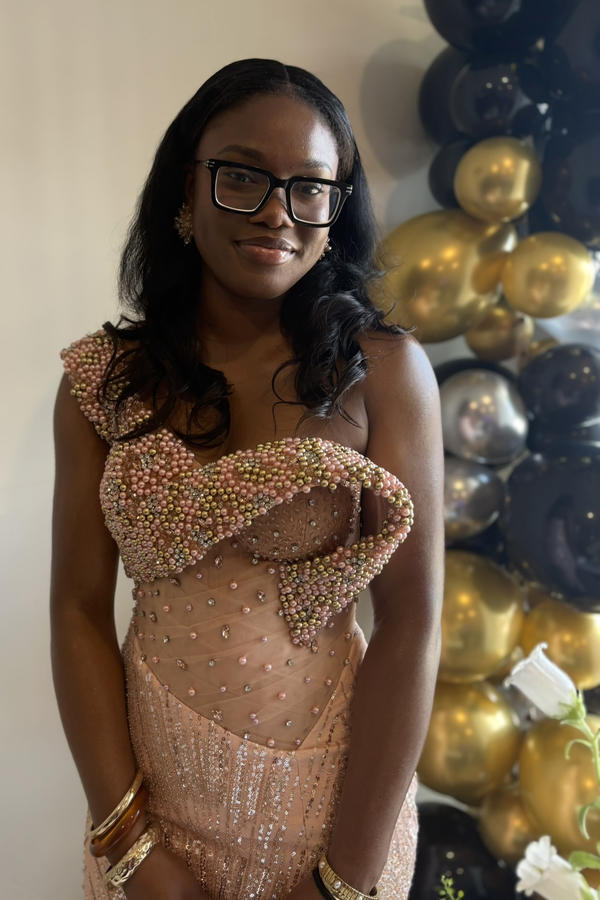 Ekanem Okon is an 18-year-old Nigerian who simply writes. Curious by nature and driven by passion, she finds herself drawn to politics, music, the arts, philosophy and social discourse. Through poetry and prose, she transforms the abstract into the tangible, thoughts into words and memories into stories. Her work often explores identity, memory, emotional vulnerability, and the experiences that shape us. Her inspiration is limitless, though it is most often found in moments with loved ones, unexpected experiences, and perhaps an unhealthy tendency to feel everything a little too deeply. Ekanem has won 2nd Place for her poem “Melanin Skin.”
Judge’s note: In “Melanin Skin” the body is metonymized for freedom, helping to better delineate its compounding parts (as especially nuanced for the policing of Black bodies)—narrative, legislation, and politics to trouble power structures and posit emancipation as part and parcel to the larger freedom struggle for Black folk—one of equity.
3rd Place: “Nadir” by Anthony Courtney
Nadir

Rickets the bridge beckoning
     in my bones. The same way
     you can't dry a nadir

     knowing.

Owning, as would Anansi have eager hatchlings harbour
     and set sail. Clutter a colony, overrail.

As the Atlantic ate
    bones instead of spider webs. We'd have to accept
        how wise, witty and enduring we are

Sea. Sea. Sea sick same, I'll float anywhere
     you bring me. I'll float
          anywhere I want. Dive/Jive.

     We have webs all over the Americas

     Dive/Jive: Blues? Jazz?
     Rock n' Roll? Bebop? Hip Hop?

     chocolate palps on beat, building
     mana wherever we can.
     We only ask: to eat, earn, be.
     with them. My home is where I want to mix with the mulch.

I'll float anywhere
     you bring me. I'll float
     anywhere I want. Dive/Jive.

Person? Black person? Person? People?

Tell me I can't live in Neptune again, along
     with whatever history you've read; even spiders sometimes float
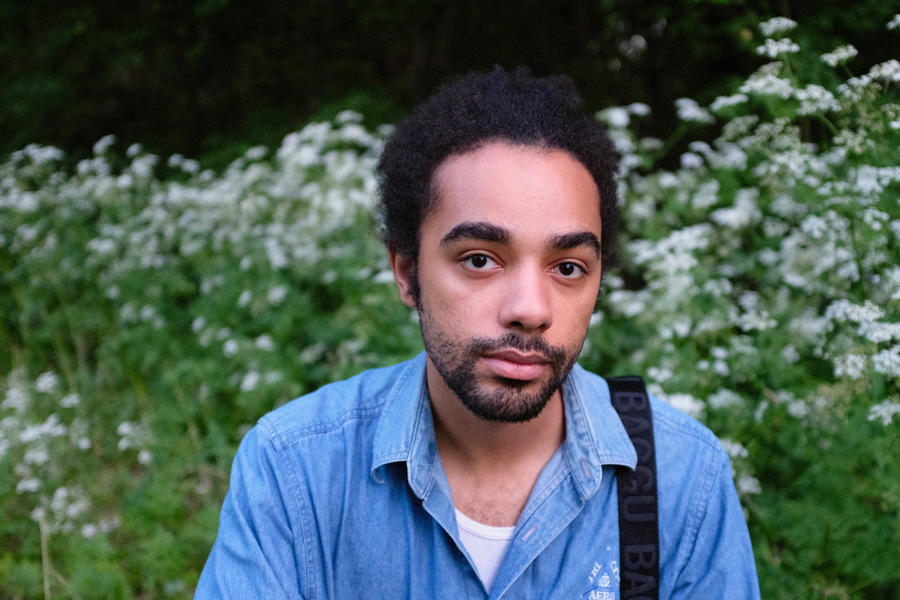 Anthony Courtney is a London born Afro-Canadian LGBTQ+ writer of poetry and song. His writing taps into diverse subjects, such as computer science, occultism and philosophy. He is currently honing his slap bass technique and horticulture. Anthony has won 3rd Place for his poem “Nadir.”
Judge’s note: With precise and imaginative language, “Nadir” extends and embodies the didactic of the African trickster God, Anancy, vis a vis enslaved peoples and their descendants to challenge the history books and present Black folk as survivor, not victim, continuing to shape culture and build community despite hardship, oppression, trafficking and ongoing racial struggle.
The 2026 Emancipation Day Poetry Contest Winners:
- 1st Place: “The first morning” by Elham Sarmastzada
- 2nd Place: “Melanin Skin” by Ekanem Okon
- 3rd Place: “Nadir” by Anthony Courtney
Congratulations to the winners and many thanks to our judges Christina Lord, Matthew Dawkins, and Harold Usher! Watch for their publication here on the website in the coming weeks.
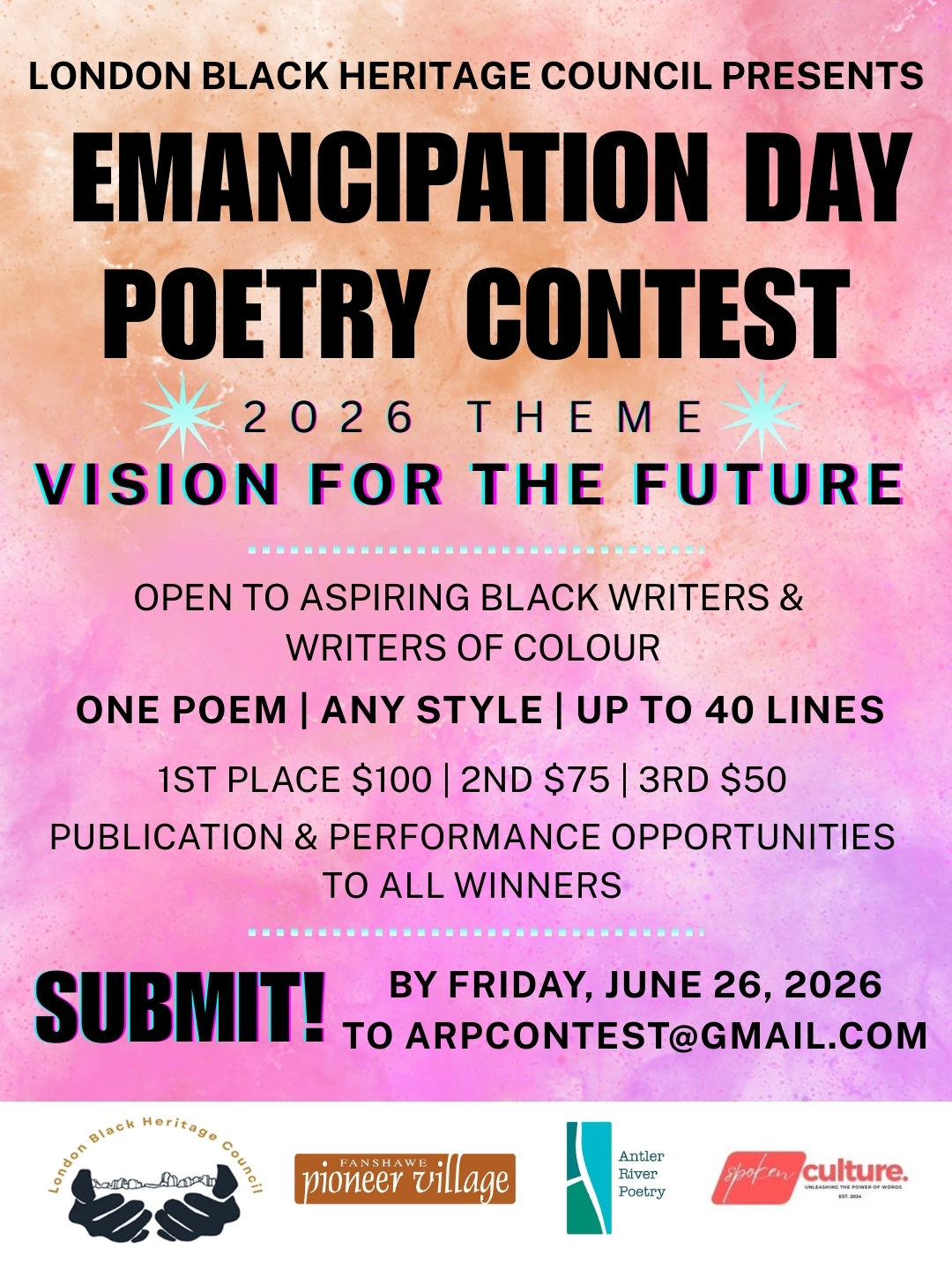
The London Black Heritage Council 2026 Emancipation Day Poetry Contest is now open!
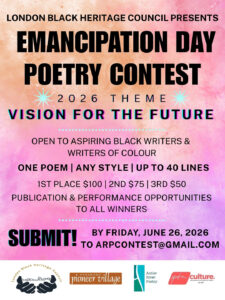 A BIT ABOUT EMANCIPATION DAY FROM LONDON BLACK HERITAGE COUNCIL:
“Slavery was abolished throughout the British colonies with the passing of the Slavery Abolition Act on August 1, 1833. Since 1834, Emancipation Day celebrations occurred in Ontario and Quebec then in communities throughout the rest of Canada in 1846 and 1858.”
This year’s celebration will take place Sunday, July 26, 2026 at Fanshawe Pioneer Village!
CONTEST DETAILS:
- Submit one poem, any style, on the theme of VISION FOR THE FUTURE
- Up to a max of 40 lines
- Original, unpublished work (no AI generated entries please)
- This contest is open to aspiring Black writers and writers of colour
HOW TO SUBMIT:
- This contest is FREE to enter
- The deadline to submit is Friday, June 26, 2026 at 11:59 PM
- Send poems in PDF format by email to arpcontest@gmail.com
- Please include your name, contact information and the title of your poem in the body of your email
- Please do NOT put your name in your PDF submission as poems will be presented to judges anonymously
- Applicants must be a resident of London/the surrounding area
PRIZES:
- 1st prize $100 | 2nd prize $75 | 3rd prize $50
- All winners are invited to read their winning submissions live at this year’s Emancipation Day Celebration on Sunday, July 26, 2026 at Fanshawe Pioneer Village
- All winners will have their winning poem published on the Antler River Poetry website, and will be invited to perform their poem live at upcoming local events by London Black Heritage Council, Spoken Culture & Antler River Poetry